Wednesday, June 19, 2024

StarLink satellite train tonight and my new AstroTom WhatsApp group


There was another Starlink launch this morning, and the new batch of 20 satellites are scheduled to pass right overhead tonight at 20:16.

If you want to hear details and are interested in my infrequent posts about astronomy then subscribe to my new WhatsApp group:

-AstroTom


Wednesday, March 1, 2023

See Venus and Jupiter meet tonight!


Venus continues to climb in the western sky. It has been lower than Jupiter for weeks, but tonight it will catch up. Venus and Jupiter will be very close (called a conjunction). 
By tomorrow Venus will be higher than Jupiter. After that, Jupiter will continue to sink and dim until it is lost in the glare of the sun by the end of the month.

See more with some great photos at EarthSky - Bright planets Venus and Jupiter at their closest


Catch Venus and Jupiter in the evening sky on 1 March 2023 from about 19:00 UTC onwards. Credit: BBC Sky at Night Magazine
Catch Venus and Jupiter in the evening sky on 1 March. Credit: BBC Sky at Night Magazine

This evening and tomorrow evening, Jupiter and Venus appear really close to one another in the evening twilight after sunset. This evening they are 0.6° apart and tomorrow they will appear 0.8° apart.

-AstroTom

Tuesday, February 21, 2023

A heavenly sight

The new moon is visible in the west with Venus above it and Jupiter above Venus.

To find the Moon, you must look very low in the west (near where the sun just set).
If you find bright Venus, just look below. 

In this photo Jupiter is barely visible at the very top, with Venus and the Moon lined up below.


-AstroTom


Wednesday, December 7, 2022

That is Mars next to the Moon tonight!


If you go outside tonight, you will see the full Moon. That very bright reddish looking star just below and to the left of the Moon is actually Mars. The planet is now at its closest and brightest for this orbit and will not be this bright again till 2032. If you miss it tonight, Mars will remain bright and visible in the evening sky for the next few weeks, but you won't always have the Moon as a guidepost. 

For viewers in northwestern Europe, or most of N. America the Moon will actually pass in front of (occult) Mars tonight. See details at 
For more on Mars and what an opposition is, see our blog:

-AstroTom


Thursday, June 18, 2020

See the planet Venus in the daytime tomorrow (Friday) morning!


People sometimes ask me, "Why can't we see the stars in the daytime?" The short answer is that the bright blue daylight sky is simply brighter than the stars. However, there are a few stars and planets that are bright enough to overcome the daylight. The most prominent is Venus, which is now well placed for a morning viewing.

You need to find a very clear day with no clouds or haze. Then you need to know exactly where to look. Venus is a very small target in the big blue sky and our eyes will not easily be able to focus on it. What we need is a landmark (or skymark) to help us.

Well, tomorrow morning (Friday) we will have help from the waning crescent moon which will appear to pass very close to Venus. Between 11:00-11:30am the moon will be about 1 moon width away from Venus. Venus will be a bit below and to the left of the moon.

The moon will be tricky to spot as it is thin, only 3 more days till new and pretty close to the sun.
To spot the moon, find a spot where you face due south and are shaded from the sun by a wall or tree. Look south and about 3/4 of the way up in the sky. 

The pair will look something like this simulation:

However, Venus will not look so large. It will be only a pinprick next to the moon.

I plan to be out in my garden between 11:00 - 11:30. Feel free to drop by if you want to join me.

-AstroTom

http://astrowife.blogspot.com
http://groups.yahoo.com/group/AstroTom/
 Stay up to date with the Sun, planets and stars.
 Subscribe to AstroTom with an email to:
     AstroTom-subscribe@yahoogroups.com


Monday, August 26, 2019

Choosing a Telescope

I just came across this well written article about telescopes that delves into the details on why a 6 inch Dobsonian is a perfect scope.


Friday, July 12, 2019

Coming up: Jupiter, Lunar Eclipse, and 50th anniversary of Apollo on the moon

Lots of astronomy in the coming days!

Jupiter is still the brightest "star" in the night sky. If you look to the southeast as soon as it gets dark, it is hard to miss. If you do need some help, the waxing gibbous Moon will be just above Jupiter on Saturday night to help guide you.

As an added bonus, try to find "The Lord of the Rings" planet, namely Saturn. It is not quite as bright as Jupiter, but brighter than any other star nearby. By about 11:00 pm it is about a hand span to the left of Jupiter when they are both in the south.
For a little help, Note that the Moon will help again as it makes it way around the sky. On Monday the 15th the Moon will be to the right  of Saturn, while on Tuesday it will to just to the left.

The moon will be full  on Tuesday night, but with a special surprise as it will slip into the earth's shadow and be partially eclipsed.

Lunar eclipse Tuesday night

Partial phase begins: 11:00 pm 
Max partial eclipse:   12:30 am
Eclipse end:               2:00 am

Tuesday is also the 50th anniversary of the Apollo 11 launch that culminated in Neil Armstrong's taking a small step on the Moon on July 20, 1969. There are lots of articles and documentaries running now about the historic moon landing

-AstroTom

http://astrowife.blogspot.com
http://groups.yahoo.com/group/AstroTom/
 Stay up to date with the Sun, planets and stars.
 Subscribe to AstroTom with an email to:
     AstroTom-subscribe@yahoogroups.com


Wednesday, June 26, 2019

Come see Jupiter and its moons

As you must have noticed Jupiter is now its closest and brightest for the year. It is perfectly placed for telescope observations.

You are all invited to come take a peek through my telescope tomorrow night, Thursday from 8:00 - 9:00 pm.

I'll be at the roundabout in Dekel Gimel across from the park, at the beginning of the security road  by the Bailey's house.


Keep looking up!
-AstroTom

http://astrowife.blogspot.com
http://groups.yahoo.com/group/AstroTom/
 Stay up to date with the Sun, planets and stars.
 Subscribe to AstroTom with an email to:
     AstroTom-subscribe@yahoogroups.com


Sunday, June 16, 2019

Full Moon rising now together with Jupiter

Check it out.

After hiding in the morning sky for months the king of planets is back in the evening sky. Jupiter is now at its brightest for the year and will be visible for the whole night.

Jupiter is the brightest "star" visible in the sky now. It rises in the southeast with sunset and sets in the southwest at sunrise. It can be found just behind Scorpio, but if you are not sure where that is, just look for the Moon tonight or tomorrow.

The pair are now (about 9:00pm) low in the southeast sky. If you can't see them yet, wait an hour or 2 till they climb above the hills and trees. They will be highest about midnight when they will be found due south.


-AstroTom

http://astrowife.blogspot.com
http://groups.yahoo.com/group/AstroTom/
 Stay up to date with the Sun, planets and stars.
 Subscribe to AstroTom with an email to:
     AstroTom-subscribe@yahoogroups.com


Saturday, January 19, 2019

Total Lunar eclipse (almost) early Monday morning

Hi All,

There will be a total lunar eclipse early this Monday morning. Here in Israel it will be tricky to see since it happens together with the sunrise so the sky will be lit up and the eclipsed moon hard to see. But if you are up for a beautiful challenge get up early. So far the weather forecast shows mostly clear skies for Monday.  

The partial phase of the eclipse will begin at 5:33am The Moon will be very low in the western sky. You will need to find a high location with an unobstructed view of the horizon. At this phase the sky will still be pretty dark as the Earth's shadow begins to touch the Moon.

By 6:00 am, as dawn begins  the moon will be about 50% covered. The shadow will continue to grow over the face of the moon till it sets at 6:40 at 97% eclipsed. At the same time the Sun will be rising in the other half of the sky. It will be interesting to note how long you can still see the eclipsed Moon as the sky lights up.

For more details and a nice animation see https://www.timeanddate.com/eclipse/in/israel/jerusalem


-AstroTom

http://astrowife.blogspot.com
http://groups.yahoo.com/group/AstroTom/
 Stay up to date with the Sun, planets and stars.
 Subscribe to AstroTom with an email to:
     AstroTom-subscribe@yahoogroups.com


Saturday, September 2, 2017

Total Solar Eclipse 2017 pictures

Total Eclipse from Cascade Idaho. Taken by my son Benjy
We had an awesome eclipse adventure this summer in Idaho


You can also see details in my FaceBook posts

-AstroTom

http://groups.yahoo.com/group/AstroTom/
 Stay up to date with the Sun, planets and stars.
 Subscribe to AstroTom with an email to:
     AstroTom-subscribe@yahoogroups.com


Sunday, January 22, 2017

Find Venus in the daytime sky

I am sure you have all been enjoying Venus in the night sky over the past few months. It is now at its  farthest from the sun in the sky and thus stays out later each night.

Since Venus is so far from the Sun, this is also a good time to practice viewing it in the daytime. 

For those of you you have followed my blog for awhile, you already know this is possible. Generally stars and planets are not visible in the daytime since the background blue sky is brighter. However Venus (and sometimes Jupiter and mars) can be bright enough to see in the daytime. The trick is to view it when:
1) it is far from the Sun so you are not blinded
2) it is high in the sky, to reduce the thick atmosphere.

The last tricky part is to know where to look. Well next week will be a great opportunity as the 4 day old moon will pass near Venus and act as a guidepost.

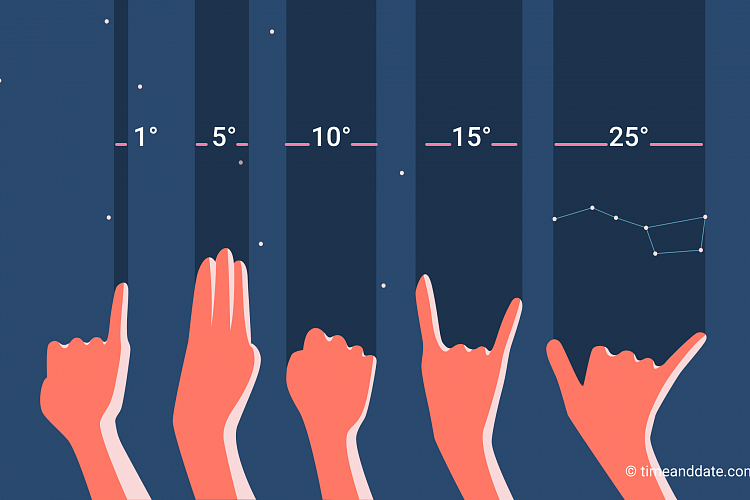
On Jan 31 go out at 2:45 pm. Find a spot facing south where the Sun is blocked behind a all or building.  The Moon and Venus will be due south. Look up about 53 degrees and you should be able to find the crescent moon. Then look up 5 more degrees and there will be Venus, clear as day.

To measure 5 degrees, use your 3 fingers of a outstretched hand (as described here)

Try it out and let us know how you do.

-AstroTom


Saturday, November 12, 2016

Supermoon?


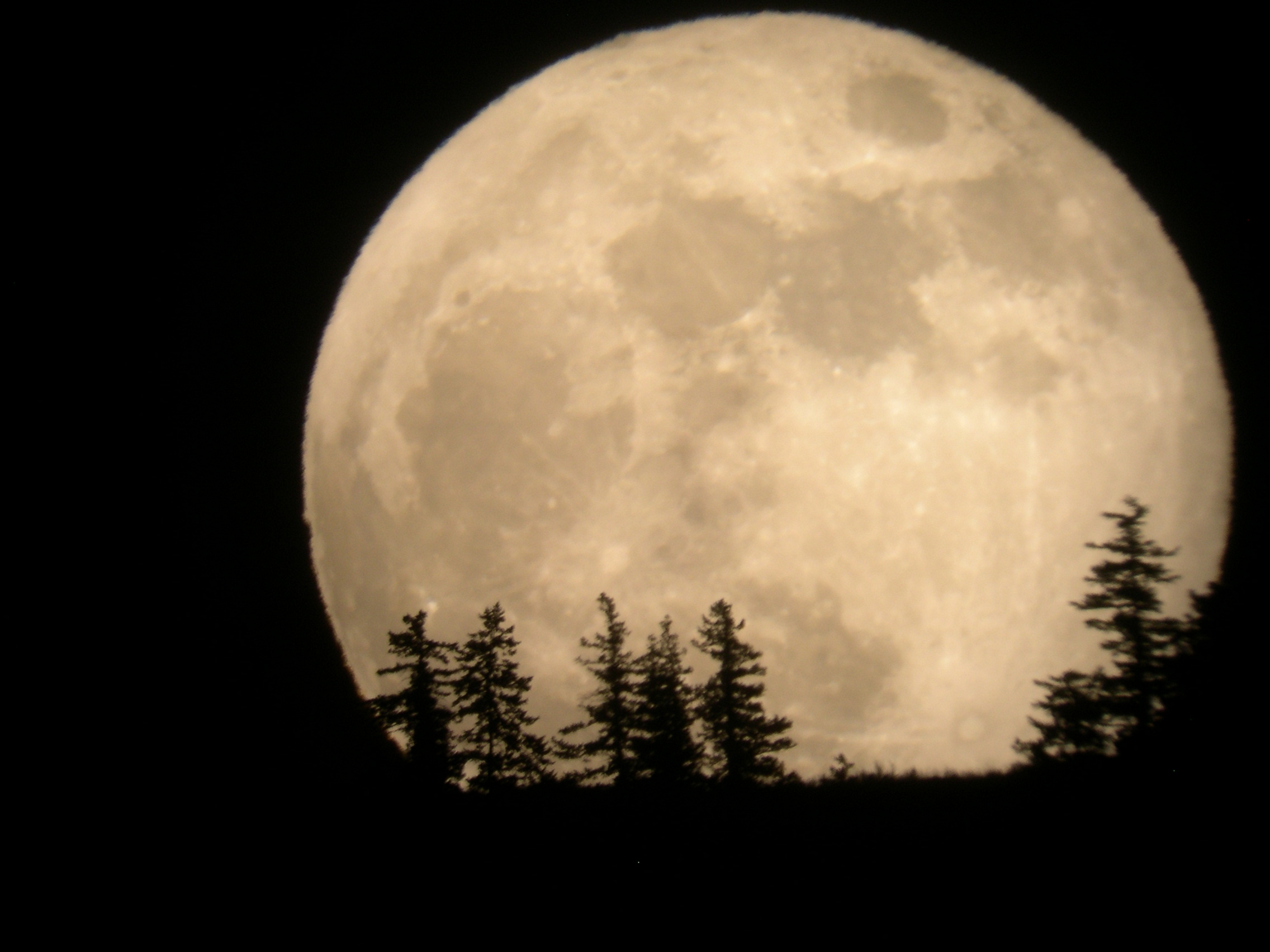
The supermoon of 2012 rises over Entiat, Wash., 
 in this photo by skywatcher Tim McCord snapped on May 5, 2012.
By now most of you have heard of the upcoming "supermoon". While it is debatable if this phenomena deserves the moniker "super", I am always happy to have people be inspired to go out and look up at the heavens (as Abraham was commanded in this week's Torah reading). 

As Neil deGrasse Tyson has said,  "If you have a 16-inch pizza, would you call that a super pizza compared with a 15-inch pizza?" 

So what is a supermoon? Since the Moon's orbit is an ellipse, there is a day every month when the Moon is a bit closer to Earth and a day (about 2 weeks later) when it is farthest. If the closest approach happens to coincide with the full Moon phase, the media has started calling it a supermoon.

For a casual observer it will be hard to detect that the Moon is any larger or brighter than the last time you saw a full Moon, However, all Moons look especially large (and pretty) when they are near the horizon during rising or setting. This is due to the famous Moon Illusion  and has nothing to do with the actual distance to Moon. So, please do go out and check out the beautiful rising full Moon on Monday night! It  will be rising about 5:15 pm here in Israel. You will need to find a spot with a clear view to the eastern horizon. Probably the best view in Efrat will be from Zayit or Te'ena.

In case you miss it on Monday, fear not as the Moon will appear almost full for a day or 2 on either side of Monday. Just keep in mind the it rises about 50 minutes later each night.

Keep looking up!

-AstroTom


Sunday, October 2, 2016

See the New Moon of 5777 tonight

Tonight is the first night of Rosh Hashana, and this year we will be able to see the New Moon of Tishre that starts the year.

The tiny crescent moon will be visible after sunset low in the western sky.
It will be easiest to see after the sky has darkened, about 6:45pm, until it set soon after 7:00pm.

More details: 


From https://moonsocil.blogspot.co.il/


-AstroTom

http://astrowife.blogspot.com
http://groups.yahoo.com/group/AstroTom/
 Stay up to date with the Sun, planets and stars.
 Subscribe to AstroTom with an email to:
     AstroTom-subscribe@yahoogroups.com


Sunday, July 31, 2016

Be ready for the summer Perseid meteor shower

Hope you are all enjoying the great show in the sky! 

We now have 4 visible planets in the sky, and if you are lucky, this Friday you may be able to see all 5 visible planets at once for the first time since 2005. I will try to write more about that later, but you can see Gadi's article in Hebrew  

Next week on Thursday night (Aug 11) will be the peak of the annual Perseid shower. This years show should be great with only a crescent moon, which will set by about midnight as the shower heats up. There are lots of organized viewings around the country including at Mizpe Ramon. Gadi has put together a list of other viewing locations and events here.

I am thinking of going to the event at Mizpe Ramon, if anyone wants to join, let me know. 


Friday, July 8, 2016

Who will be the first to spot Venus?


shadowandsubstance.com
I have gotten used to sharing the evening sky with our 3 visible superior planets of Saturn, Jupiter and Mars. They are called "superior" not because they are smarter, but because they are farther from the Sun then we are.

However, the "inferior" planet Venus is about to make a comeback. After spending nearly a year in the morning sky, Venus just finished rounding the far side of the Sun and is coming back to our night sky.

Because of the season, the ecliptic now makes a shallow angle with the western horizon after sunset. This means that although venus will be getting farther from the Sun each night, it will not move much above the horizon, making viewing difficult. However, I have already heard of one report of someone in Israel finding Venus in binoculars.

Tonight Venus will set by 8:20 pm, only about 35 minutes after sunset. Each night venus will set a minute or 2 later. By the beginning of August Venus will still only be about 4 degrees above the horizon 1/2 hour after sunset. But bright enough for keen observers to spot.

See this great  animation  of Venus and all the the other visible planets dancing in the western sky over the next year. It is created by the Shadow and Substance guy. Note that Venus and Jupiter will pass in a very close conjunction on Aug 28th. Stay tuned for more on that later.


So keep looking up, and let me and the list know if you are able to spot Venus!


-AstroTom


Heavenly Update


I hope everyone has been enjoying our clear skies and views of Mars over the past few weeks. The Earth is pulling ahead of Mars now, so it is getting a little smaller and less bright each night. But Mars is still the brightest "star" in its area of the southern sky.

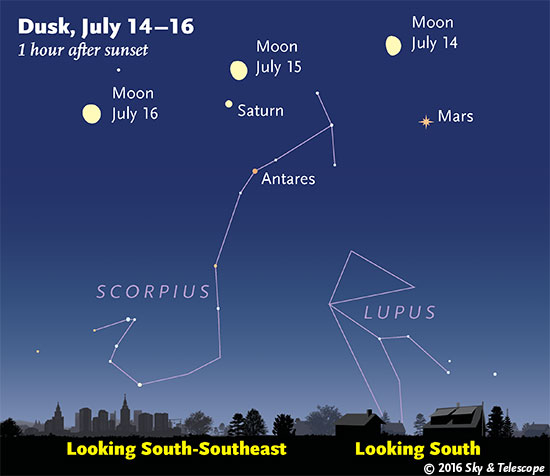
http://www.skyandtelescope.com/observing/sky-at-a-glance/this-weeks-sky-at-a-glance-july-8-16/
From Israel the Moon will be a bit to the right of what is shown here.
Now that the new crescent Moon of Tammuz is out, we can use its help to find 3 planets over the coming week. Tonight on your way home from Shul, look for the thin crescent Moon in the west. You will then see a very bright "star" to its left. That will be Jupiter!

As the Moon continues it journey around the Earth it will pass Jupiter and appear to its left by tomorrow night (Sat). By next Thursday the Moon will cruise to just above  Mars in the southern sky. Two days later on next Friday, the Moon will be to the right and above Saturn. The Ringed Planet is now about 1/2 as bright as Mars in a cluster of bright stars, but the Moon will help you spot it.


-AstroTom


Sunday, May 22, 2016

Mars is now it's closest to Earth


If you were wondering what that really bright "star" in the sky is, it is Mars!

Because of the way our orbits work, Mars and the Earth line up about once every 2 years. (You probably learned that watching "The Martian"). Mars now rises at sunset and is up all night. By about 9pm it is high enough in the southeast to be easily visible. Although it is hazy tonight, you can still find it near the full Moon. (After tonight, the Moon will be getting farther from Mars in our sky, so not as useful as a landmark.


-AstroTom

http://astrowife.blogspot.com
http://groups.yahoo.com/group/AstroTom/
 Stay up to date with the Sun, planets and stars.
 Subscribe to AstroTom with an email to:
     AstroTom-subscribe@yahoogroups.com


Wednesday, May 11, 2016

Mercury transit report


On the roof in Rosh Haayin (thanks to Monica)

On Monday the weather was rather hazy here. I brought my Mead ETX 90 with a solar filter to the roof at work in Rosh Haayin to share the view with my co-workers. You can see how hazy it was by the lack of shadows in the picture above. (See more pics) We did get a few moments of good seeing when we were able to spot Mercury.

As it turns out later in the afternoon the sky did mostly clear up, but by then I was on the road. However my friend Gadi, in Petah Tikva was ready and captured some nice photos and video. See his report in English or Hebrew.

Sunday, May 1, 2016

Transit of Mercury next week


When Mercury swung in front of the sun on November 8, 2006, it appeared as a small black dot (lower right of center), not nearly as conspicuous as the big sunspot at the left edge of the solar disk. Photo by Brocken Inaglory.
(from 
http://earthsky.org/?p=234431)
Next week on Monday May 9th will be a rare transit of Mercury across the face of the sun. This means our innermost planet will be passing directly between the Earth and the Sun. The last time this occurred was 2006, but was not visible from Israel. It will not happen again till 2019. 

(For pictures of the 2006 transit captured in Efrat see here.)

In order to view the transit you will need special equipment. There will be a public viewing in Bet Shemeh by the Dubeh HaGedolah group. See this link for info and to sign up.

If you can't make it to Bet Shemesh you can see a great simulation at http://www.shadowandsubstance.com/ There will also be a live streaming event at http://www.ccssc.org/webcast.html starting at 2:00pm Israel time.


-AstroTom

http://astrowife.blogspot.com
http://groups.yahoo.com/group/AstroTom/
 Stay up to date with the Sun, planets and stars.
 Subscribe to AstroTom with an email to:
     AstroTom-subscribe@yahoogroups.com