Wednesday, May 22, 2013

Venus is back!

Hi All,
Another beautiful  day with blue skies. That means that right after sunset you will be able to greet  returning Venus.

Venus hasn't been seen in our night sky since last June when she disappeared passing in front of the sun to visit the dawn sky. She is now back in the evening after peeking out from behind the sun as her orbit swings back to our direction.

Venus now appears far enough away from the sun to be easily visible as soon as it gets dark, already outshining Jupiter to its upper left


So, be sure to run outside around 8pm to see Jupiter and Venus lined up together with Mercury. You will need a clear view low to the west. Venus will be about 1 fist (5 degrees) above the horizon, and the other 2 planets on either side as shown above.

Mercury will be more of a challenge to see as it is only magnitude -1 (compared with 3.3 for Venus) but eagle eye hunters should spot it in our clear israeli skies. I got a call last night from  Andy Schwartz, who spotted the trio as he was  walking down the street. If your eye's aren't as good as Andy's you cheat and use binoculars (like I did).

Be sure to look for the trio for the coming night as they will dramatically change position till only Venus is left visible by the beginning of next month.

-AstroTom

http://astrowife.blogspot.com
http://groups.yahoo.com/group/AstroTom/
 Stay up to date with the Sun, planets and stars.
 Subscribe to AstroTom with an email to:
     AstroTom-subscribe@yahoogroups.com


Friday, May 10, 2013

See the New Moon and New Venus Saturday night

The new moon of Sivan will be visible on Sat night.
It should be easy to spot by 7:45 pm low in a little to the north of west.

Venus is also coming back into view in the evening, after spending nearly a year in the morning sky. It will be harder to catch than the moon, as it will be lower and closer to the glow of the sun. If you have binoculars, you will increase your chance of bagging this planet. But you will have to hurry before it sets by 8:10pm.

The sky will look like the illustration below, with the moon a little closer to Venus than shown. Jupiter, the Moon and Venus will make a nice straight line showing of the ecliptic of our solar system.

Crescent moon between Venus and Jupiter after sunset May 11
But fret not, if you miss Venus Saturday, it will be getting higher and brighter everyday. 
Of course one last difficulty will be the partly cloudy skies forecast for thew next few days. But you never know when a planet or moon may peek through.


Friday, April 26, 2013

Another space station pass tonight


Hope you all enjoyed the celestial show last night! I was surprised  at how obvious the partial eclipse was visible to the naked eye. Here is a picture from my friend Gadi:

Inline image 1

Tonight we get an encore of lasts nights show, including an ISS pass, Saturn, the Moon, and Jupiter. The only thing missing is an eclipse, but you can't have everything.
Inline image 2
The first "star" to pop out in the west after sunset is Jupiter. By 7:45pm, the sky will be dark enough that Jupiter will shine alone in the the western sky a bit to the right of where the Sun set. As it gets darker, more bright stars will appear, but Jupiter will still outshine then till  it sets at 10pm.

Next comes the  space station. The ISS will not be as bright or high as yesterday, but the pass will be longer lasting about 3 minutes. Check it out after Shul as it rises in the northwest at  8:08pm. It will then head southeast about 1/2 way up the sky, passing the bright star Arcturus, and fading into the earth's shadow at 8:11, just before meeting Saturn near the SE horizon. (For advanced users, you can see the star map here.)

After the pass, see if you can spot Saturn, even before the Moon rises (at 8:15pm). It will actually be easier to find without the glare of the Moon right next door. It will be the brightest "star" just above the eastern horizon near where the space station disappeared. If you don't have a clear view of the  horizon you may need to wait an hour or 2 for Saturn to clear the hills and trees. The Moon will now appear below Saturn and about twice as far away as it was last night.

The view at about 9:00pm.


(We are actually going to have a visible ISS pass for the next 4 nights. You can find details yourself at heavens-above, or sign up for alerts at spotthestation.nasa.gov)

-AstroTom

Subscribe to AstroTom with an email to:
     AstroTom-subscribe@yahoogroups.com


Thursday, April 25, 2013

See the Space Station tonight + a bonus of planets


 Chasing the ISS
We are in luck again as the International Space Station will be passing over our skies in Israel. The angle with the Sun is just right,  so that  even though it is way past sunset down here on the surface of the Earth, it is still sunny 200 miles up by the space station.  The ISS will reflect the sunlight as it passes, appearing like a very bright star slowly moving across the sky.

It will rise from the northwest horizon at  8:57 appearing like a very bright star. It will be hard to miss, as it will be brighter than any other star. The space station will head pretty much to a point overhead. where it will abruptly disappear 3 minutes later. This is because it will no longer be in the sunlight as it passes into the shadow of the Earth over our heads.
While you are out do notice the full Moon rising low in the east. As a bonus, notice the bright star to the lower left of the moon which is actually the planet Saturn! (For extra credit, you can also find Jupiter, as the brightest "star" hanging out in the west.)
For more, including details on the secret eclipse tonight, see the previous post.

Wednesday, April 24, 2013

Saturn and the Moon


Just a quick note to let y'all know to be on the lookout for Saturn. The ringed planet is coming up to its "opposition" on Sunday the 28. That simply means that Saturn,  Earth and Sun will all be on a straight line and thus, the planet will be opposite the Sun in our sky. As the Sun sets in the west, Saturn will rise in the east. Although the 6th planet will be above the horizon all night, it will be easier to spot an hour or 2  after sunset when it will be higher in the sky.
Our Moon will be on duty to help you find Saturn this week. On Thursday night the full Moon will lead about 5 degrees in front of Saturn. The pair will march across the sky all night long. The next night on Friday, the Moon will trail about 10 degrees behind Saturn. Either night the brightest "star" you see near the Moon will be Saturn.

Thursday's full Moon will also experience a partial eclipse at  11:07pm Israel time. However it will be tiny, only be about 1% of the moon will be covered, so it will be nearly invisible to casual observers. We'll have a long wait till Sep 2015 before the next lunar eclipse visible from Israel.


-AstroTom


Wednesday, March 20, 2013

Welcome to the Spring Equinox

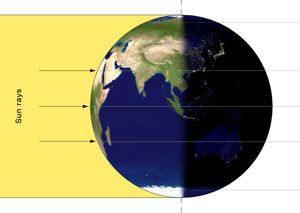
Today is the first day of spring. The actual equinox will occur at 13:02 Israel time. That is when the sun will cross the celestial equator from south to north, continuing its climb to higher in our sky each day, adding more warmth and minutes of daylight.
earth_lighting_equinox_300

It is indeed a perfect spring day here in Israel. The sky is very clear, so maybe tonight will be a good chance to spot comet PanStarr, before it fades too much as it speeds away from the sun.


Comet PANSTARRS appears briefly in the west after sunset in March 2013. This comet appears beneath the waxing crescent moon on March 14, above the star Algenib on March 17/18, and above the star Alpheratz on March 25/26. It finally meets with the Andromeda galaxy in early April.


-AstroTom

Wednesday, March 13, 2013

Comet PanSTARRS

Hi Y'all,

Has anyone managed to spot the new comet yet?


Comet PanSTARRS has just moved from the southern hemisphere, to visibility in the northern hemisphere. The past 2 day where supposed to be ideal here as it passed by the new crescent Moon in our sky. Unfortunately the sky has been hazy and not very clear.

The comet is net very bright, and only visibly in twilight so it will be tricky. You will almost certainly need binoculars.As you see in the illustration above, each day PanSTARRS will be getting a little higher above the horizon and thus farther from the Sun's glare, but at the same time it is expected to get dimmer as it speeds away from the Sun on its orbit back to the edge of the solar system.


Let us know if you catch it!

-AstroTom 

http://astrowife.blogspot.com
http://groups.yahoo.com/group/AstroTom/
 Stay up to date with the Sun, planets and stars.
 Subscribe to AstroTom with an email to:
     AstroTom-subscribe@yahoogroups.com